ACRES#
ACRES is the Agricultural Control and Robotics Environment Simulator. It simulates a tractor and a utility vehicle with their sensors on a surveyed tile of the Purdue ACRE farm.
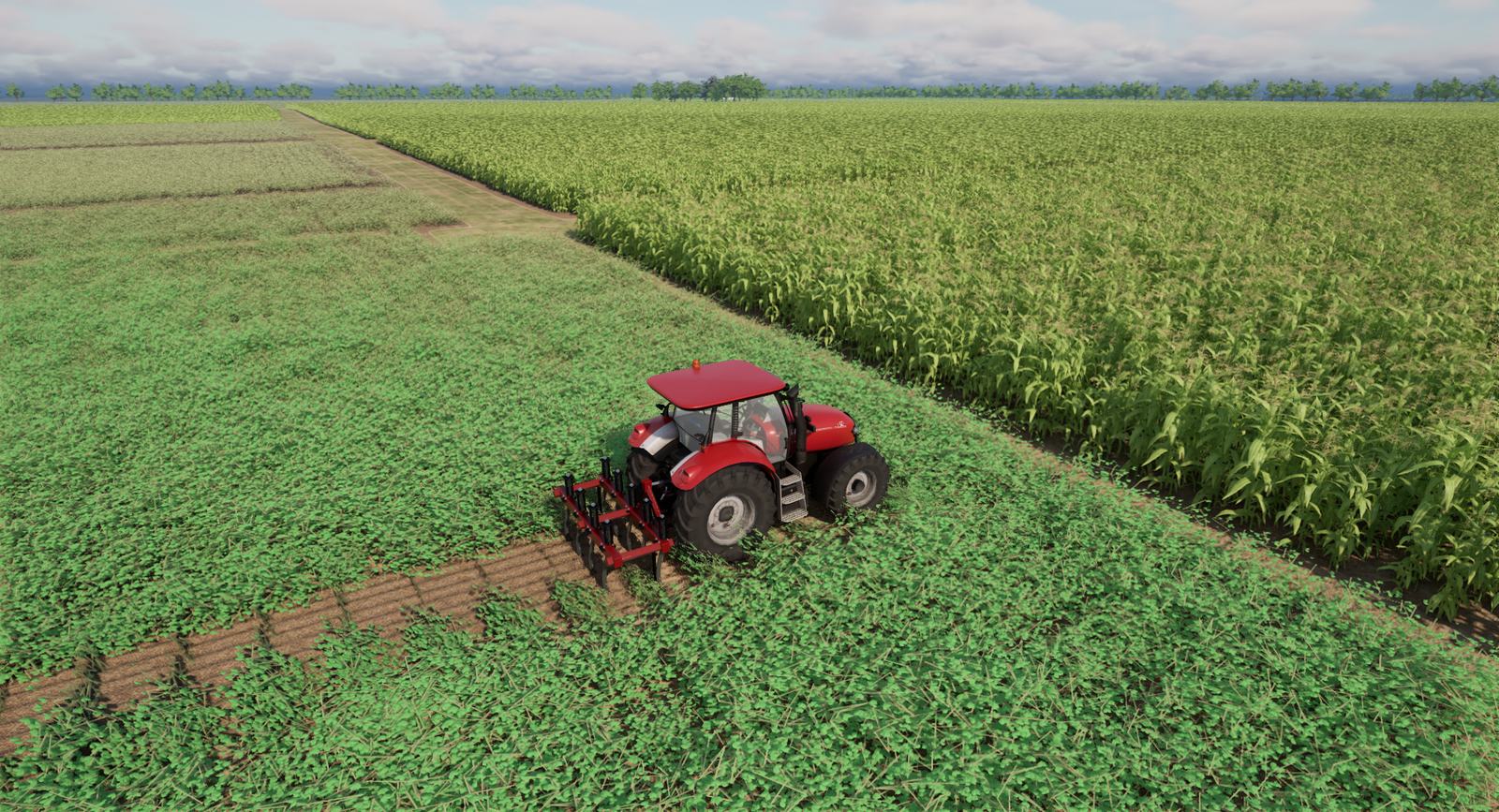
What ACRES Is#
ACRES is a research simulator for agricultural robotics, built with Unreal Engine 5.8. The world is a measured tile of the Purdue Agronomy Center for Research and Education (ACRE) in Indiana. Two vehicles drive in this world. The first is the Case IH Maxxum 150 tractor with eight implements. The second is the Polaris Ranger of the Purdue lab with its Dataspeed drive-by-wire.
The soil deforms, the crops grow, rain runs off and soaks in, and the weather changes during the day. A set of simulated sensors writes data with one clock and with real-world coordinates.
ACRES has two simulators that share one set of models. The game is the full simulator with the renderer and all sensors. ACRES Core is the simulator without Unreal. It runs many environments in parallel for learning.
What ACRES Is For#
| Use | Description |
|---|---|
| Collect data | Record camera images, LiDAR clouds, INS, GNSS, IMU and CAN data with ground truth. |
| Train | Train a driving policy in ACRES Core at many times real time. |
| Simulate and evaluate | Run your ROS 2 software or a policy in closed loop, in lockstep when you need determinism. |
| Export and deploy | Run the same software on the real Polaris. The topics, types and frames agree. |
System Overview#

The numbers in the diagram show the four data flows.
- Collect data. The game writes a session log and sensor episodes. The game and ACRES Core write an episode log. ROS 2 tools record a bag.
- Train. A learner steps a batch of ACRES Core environments. It sends drive-by-wire commands and receives observations.
- Simulate and evaluate. Software on ROS 2 drives the vehicle through the ROS 2 bridge. The game replays an episode log to make images.
- Export and deploy. The lab runs the same software on the real Polaris. The recorded logs of the vehicle give the parameters of the models.
Components describes each box of the diagram.
Where to Start#
Install the tools, build the game, ACRES Core and the ROS 2 workspace, and drive.
Drive each vehicle, operate the implements, set soil and weather, and collect data.
The full mathematics of the vehicles, the soil, the implements, the farm and the sensors.
Command-line options, sockets, ROS 2 interfaces, the Core API and the file formats.
The architecture, the design choices with their reasons, the limitations and the roadmap.
The benchmark tasks. The first task is field scouting with the Polaris.
The learning framework, the training, the deployment and the verification.
The repository layout, the conventions, the tests and how to extend ACRES.
Status#
ACRES is a research prototype.
| Item | Status |
|---|---|
| Polaris Ranger | The logs of the real vehicle give the parameters of its dynamics, drive-by-wire, LiDAR and camera. |
| Weather and soil water | The Purdue Mesonet record of ACRE sets the conditions of a given day. |
| Maxxum 150 and implements | The values come from publications and datasheets. No measurement at ACRE exists. |
| Platforms | The repository packages and tests the game on Linux. Windows has one recorded build and drive test. |
Limitations gives the full list. Platforms and GPU Tiers gives the requirements.