Verification#
The folder Verification/ holds a Lean 4 development. It models parts of ACRES, proves properties of the models and
tests the models against the real code. This page gives the theorems, their assumptions, the findings and the method
to run the checks.
Status
A check against the Lean source on 2 October 2026 confirmed each theorem name on this page. The check script passed on that date with an audit of all 3,269 library constants. The Lean models of the Framework exist. The production code of the residual law, the shield, the automaton module, the residual reward and the plan checker does not exist. The Lean models are the specification of that code.
What Lean Proves#
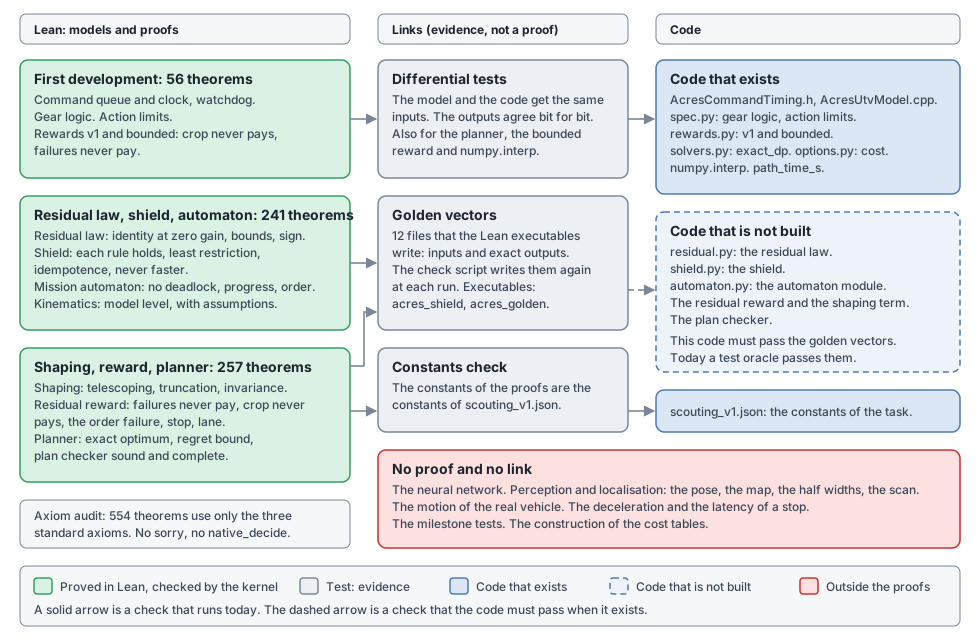
A proof is about a model. Four links connect a model to the code.
| Link | Function |
|---|---|
| Differential test | The model and the code get the same inputs. The outputs must agree bit for bit |
| Golden vectors | The Lean executable writes inputs and outputs to files. Code that does not exist must pass these files later |
| Constants check | The check script compares the constants of the proofs with configs/scouting_v1.json |
| Axiom audit | Lean checks every project constant. Only the three standard axioms are permitted |
No link is a proof. A link gives evidence that the code does what the model does.
Subjects#
| Subject | Real Code | Lean Model | Lean Proofs | Link to the Code |
|---|---|---|---|---|
| Command queue and clock | Acres/Source/Acres/AcresCommandTiming.h |
CommandTiming.lean |
Proofs/Queue.lean, Proofs/Clock.lean |
Differential test |
| Command path and watchdog | AcresPolaris.cpp (StepPolarisControls), AcresUtvModel.cpp (StepDbw) |
Watchdog.lean |
Proofs/CommandPath.lean, Proofs/FloatFacts.lean |
Differential test |
| Gear logic | spec.GearManager |
GearManager.lean |
Proofs/GearManager.lean |
Differential test |
| Action limits | spec.action_to_command, spec.command_rows |
ActionMap.lean |
Proofs/ActionMap.lean |
Differential test |
| Step reward | rewards.step_terms, rewards.step_reward |
Rewards.lean |
Proofs/Rewards.lean |
Differential test |
| Bounded reward | rewards.bound, rewards.bounded_reward |
Reward/Residual.lean (boundedStep) |
Proofs/FailureBound.lean |
Differential test |
| Residual law | Not built | Shield/Residual.lean |
Shield/Proofs/Residual.lean |
Golden vectors |
| Shield | Not built | Shield/Shield.lean |
Shield/Proofs/ |
Golden vectors |
| Mission automaton | mission.EpisodeTracker has the transitions. The module is not built |
Mission/Automaton.lean |
Mission/Proofs.lean |
Golden vectors |
| Shaping term | Not built | Shaping/Model.lean |
Shaping/ |
Golden vectors; numpy.interp by differential test |
| Residual reward | Not built. The constants are in the configuration | Reward/Residual.lean (residualStep) |
Reward/ |
Golden vectors; constants check |
| Planner | solvers.exact_dp, OptionGraph.cost |
Planner/Model.lean (solve) |
Planner/Optimality.lean, CodeCost.lean, Regret.lean, RegretTight.lean |
Differential test; golden vectors |
| Plan checker | Not built | Planner/Model.lean (checkProposal) |
Planner/Checker.lean |
Golden vectors |
The Lean files are in Verification/AcresVerification/. The Python files are in Learning/acres_learn/tasks/scouting/
and Learning/acres_learn/planners/.
Method#
- One model for each component. Each model follows the C++ or Python code statement by statement. The model uses a
scalar type
α. Helper functions reproduce the library functions of the code with their NaN rules. These functions arestd::clamp,std::max, themaxof Python,numpy.minimum,np.clipandnumpy.interp. They also include the compensatedsumof CPython, the order ofnumpy.sumand the fusedddotof OpenBLAS. - A model before the code. For the framework, the Lean model is the specification. The code comes after the model and must pass the golden vectors.
- Proofs over exact numbers. The proofs use the models with
α = ℚorα = ℝand Mathlib. -
Tests over doubles. Three executables run the models with
α = Float(IEEE 754 binary64).Executable Source Models acres_modelMain.leanCommand path, gear logic, action map, step reward acres_shieldShieldMain.leanResidual law, shield, mission automaton acres_goldenGolden.leanShaping term, bounded and residual reward, planner, plan checker -
Axiom audit.
audit_project.pyfinds every library source file, including files absent from the main import. Lean checks every constant by its source module. This includes private names, helper definitions and lemmas. Onlypropext,Classical.choiceandQuot.soundare permitted. A new axiom fails even if no theorem uses it. Proof gaps fail even when a source file disables the warning forsorry. The build fails on warnings. The three executable roots have separate audits because each definesmain. The audit helper also has a constant audit. An unknown source outside the library fails registration. Historical files inReviews/are outside this gate.
Floats. A proof over exact numbers leaves a gap to the doubles. These measures reduce the gap.
- The proofs of the timeout arithmetic of the watchdog use the real doubles. Lean defines
Floatby a model of binary64. The tacticdecide +kernelevaluates this model in the kernel (Proofs/FloatFacts.lean). - The proofs of the bounds and the order of the action map cover each double, with NaN and infinities. The proof uses two properties of IEEE rounding: it is monotone, and it does not change a double.
- The gear logic only compares, negates and takes absolute values. Doubles do these operations exactly. Thus its proofs over ℚ are true for each finite double.
- The clamps of the shield only compare and select. The clamp lemmas are true for each linear order, thus for finite
doubles (
Shield/Proofs/Clamp.lean). - Some shield theorems are for each scalar type,
Floatincluded: the stop on unusable inputs, the intervention flag and the output curvature. - The kernel evaluates named doubles for the shield, the residual law and the bounded map
(
Shield/Proofs/FloatFacts.lean,Reward/FloatFacts.lean).
Theorem Counts#
The release gate audits 3,269 library constants. Of these, 1,765 are kernel theorem constants, including generated helpers. These counts are not counts of independent safety properties. The executable roots also have audits.
The older lists retain 554 named theorem entries for reference:
| Audit File | Theorems | Scope |
|---|---|---|
Verification/Audit.lean |
56 | The headline theorems of the command path, the gear logic, the action limits and the rewards v1 and bounded |
Verification/AuditShield.lean |
241 | Each theorem of Shield/Proofs/ and Mission/Proofs.lean |
Verification/AuditFramework.lean |
257 | Each theorem of Shaping/, Reward/ and Planner/ |
These lists help readers find named results. They do not determine audit coverage.
AuditAll.lean checks the imported environment; audit_project.py supplies the complete module list.
| Group | Files | Theorems |
|---|---|---|
| Residual law | Shield/Proofs/Residual.lean |
30 |
| Shield | Shield/Proofs/Caps.lean, Clamp.lean, Meta.lean, Rules.lean, FloatFacts.lean, Framework.lean |
139 |
| Kinematics | Shield/Proofs/Kinematics.lean |
27 |
| Stop command path | Shield/Proofs/CommandPath.lean |
8 |
| Mission automaton | Mission/Proofs.lean |
37 |
| Shaping | Shaping/Telescoping.lean, Mdp.lean, Potential.lean, Augmented.lean |
117 |
| Residual reward | Reward/ResidualProofs.lean, Spec.lean, FailureEvent.lean, FloatFacts.lean |
78 |
| Planner | Planner/Optimality.lean, CodeCost.lean |
26 |
| Regret | Planner/Regret.lean, RegretTight.lean |
23 |
| Plan checker | Planner/Checker.lean |
13 |
Review Findings and Current Status#
The independent review of 2 October 2026 found no non-standard axiom in the current project constants.
The report is in Verification/Reviews/lean-review-2026-10-02.md. The review found these gaps in the release checks.
- Audit coverage: closed. The gate checks all project constants and fails on warnings. Tests inject proof gaps and new axioms into a private copy.
- Production code. Six components still use test mirrors: the residual law, shield, automaton, shaping term, residual reward and plan checker.
- Trainer reward contract: closed. Residual PPO must use raw rewards:
normalize_rewards=false,reward_clip=nullandgamma=0.995. The trainer rejects other settings for that variant. The production variant remains disabled. Historical baselines retain their reward transforms; the proofs do not cover those transforms. - Step limits: guarded. The gate checks both PPO configurations, projection window, path spacing, map parameters and milestone values. A geometric check finds at most four checkpoints in any coverage disc on the current map. Runtime guards for the residual variant reject excessive progress, checkpoint counts, multiple milestones and invalid energy or area inputs. These checks do not prove the vehicle dynamics.
- Failure comparisons. The same-step theorem assumes a lower bound on the continuation value. A later collision can violate that bound.
- Shaping scope. Policy invariance is proved for finite processes. No theorem connects that process to the continuous scouting task.
- Shield scope. The main rule proofs use real numbers. Tests cover doubles; motion proofs use explicit assumptions about speed, braking and latency.
- Mission connection. The automaton tests do not compare the model with
EpisodeTracker.
A green check is evidence for the listed checks. It does not establish that the residual framework is ready for training.
Run the Checks#
-
Install elan, the Lean toolchain manager. Root access is not necessary.
-
Get the Mathlib build cache and build one time. The cache is 7.7 GB in
Verification/.lake/. -
Run all checks from the repository root.
The toolchain is Lean 4.34.1 (Verification/lean-toolchain). Mathlib is v4.34.1 (lakefile.toml).
check.sh does these steps:
- It discovers the proof sources and builds all models with warning failures.
- It audits every project constant.
- It checks reward assumptions against configuration, code constants and map geometry.
- It runs the shield and mission tests against the reference mirrors and golden vectors.
- It compiles the drive-by-wire harness from the game sources and runs the differential tests.
- It writes the golden vectors again and compares them with the committed files.
- It runs the shaping, reward and planner differential tests.
Run the deliberate-failure tests separately. They use a temporary copy and keep the working sources unchanged.
~/miniconda3/envs/torchenv/bin/python Verification/mutation_tests.py --output /tmp/acres-mutation-results
The tests reject proof gaps, unused axioms, proof warnings and unregistered sources. They also reject changed discounts, reward weights, failure penalties, milestones, geometry settings and golden vectors. Both the original and restored copies must pass the gate.
| Variable | Default | Function |
|---|---|---|
SEQUENCES |
1000 | Generated sequences for each component |
SEED |
20260930 | Seed of the sequences |
BUILD_DIR |
$TMPDIR/acres-verification |
Folder for dbw_harness and the new golden files |
PYTHON |
python3 |
An interpreter with numpy |
LAKE |
lake, else ~/.elan/bin/lake |
The build tool of Lean |
The earlier run of 2 October 2026 printed these differential results. The current gate adds the full constant audit and the reward-assumption checks described above.
axiom audit: 56 theorems, standard axioms only
axiom audit (residual, shield, mission automaton): 241 theorems, standard axioms only
shield: the oracle mirror is identical on 4943 golden shield cases (2988 interventions, 557 stops for inputs that are not usable), 1527 golden residual cases, 10000 fresh shield cases, 2000 fresh residual cases; the golden files are as the Lean model prints them
mission: the oracle mirror is identical on 4624 golden sequences (30496 events), 1000 fresh sequences; the golden files are as the Lean model prints them
constants: as the proofs assume (36 constants)
timing: identical on 1000 sequences, 1533411 events, 452709 steps, 160742 steady_steps, 27 startup_timeouts, 249 stops_checked, 434 pauses_checked
gear: identical on 4000 sequences, 434096 calls, 5801 shifts
action: identical on 14060 actions, True nan_to_zero
reward: identical on 10000 steps, 3 steps where libm pow(x, 2) is one ulp off x * x, 4 fields within their ulp
axiom audit (shaping, reward, planner): 257 theorems, standard axioms only
golden vectors: 7 files, as the models write them
shaping constants: gamma 0.995, shaping_cost_per_step 0.55, shield_per_step 0.5 constants
shaping interp: 9552 numpy.interp queries
shaping potential: 220 golden shaping steps, 8 tables, not written yet (reference implementation only) production shaping code
shaping returns: 12 golden episodes, 3.0727130355551687e-16 largest relative gap of the telescoping identity
shaping reference time: 20 paths against deploy.mission.path_time_s, 8.434857979685428e-16 largest relative difference
reward constants: as the reward proofs assume constants
reward bounded: 5000 steps of variant=bounded, 2313 of them below the knee, 1268 values of rewards.bound, 1 steps where libm pow(x, 2) is one ulp off x * x, 1 fields within their ulps
reward bounded golden: 14 golden values of rewards.bound
reward residual: 49 golden residual steps, 0 with libm's pow one ulp off, not written yet (reference implementation only) production residual reward
reward floats: bounded_reward is above the floor and non-decreasing on a grid of 0.005 over [-1000, knee]; among adjacent doubles in [-60, knee] 8.2 % are reversed (by rounding); it first reaches the floor near -3.16e+08 (a position 25 km off the corridor), and bounded_reward(-1e17) = 0.0 doubles
planner code: raises ValueError (the model: the empty plan, cost 0) exact_dp on a mission without fields
planner instances: 53 golden instances, 52 feasible, 12 with many ties
planner random: 500 random tables, 13 without a feasible plan
planner regret: 8 regret cases, 0.141 largest regret over its bound
planner checker: 16 checker cases, 3 accepted, 52 optimal plans accepted, not written yet (reference implementation only) production checker
verification: all checks passed
Three lines contain "not written yet". They name code that does not exist. For that code, the script tests a
reference implementation in the test file against the golden vectors. The lines shield and mission test an
oracle mirror. An oracle mirror is a test oracle, not the production code.
Theorems#
This table lists the theorems of the first development: the command path, the gear logic, the action limits and the
rewards v1 and bounded. The sections from Residual Law give the theorems of the framework.
| Component | Property | State | Theorems |
|---|---|---|---|
| Command queue | The steps apply the snapshots in arrival order | Proved for all times | applied_sublist, applied_increasing |
| Command queue | The length has a bound: one entry for each different due time; +2 over a pause; +1 in lockstep | Proved | length_le_of_dues, pause_bound, lockstep_bound |
| Command queue | The length has a bound by the number of different due steps | False (not a hazard) | due_step_counterexample |
| Command clock | Arrival order stays; gaps do not become longer | Proved | due_mono, due_gap |
| Command clock | The messages of the first read all apply at the next step | Proved (finding 3) | first_read_next |
| Watchdog | Commands at intervals of 20 ms or less never time out | Proved with assumptions A1 to A4 | never_times_out |
| Watchdog | A silent subsystem disengages within \(T + dt\) and not before \(T\) | Proved; the game trips one step before ACRES Core | disengages_after, core_trips, game_trips |
| Gear logic | No gear command while \(\lvert v \rvert \ge 0.1\) m/s | Proved | no_gear_cmd_moving |
| Gear logic | The ULC speed is never against the gear; it is 0 for 1.2 s after a shift | Proved for finite inputs | ulc_along_gear, ulc_zero_after_shift |
| Gear logic | At most one gear change in 1.2 s; none inside the ±0.2 m/s band | Proved | shifts_spaced, no_shift_in_band |
| Gear logic | A constant command gets its gear, then its speed | Proved, if the vehicle stops | reverse_liveness, forward_liveness |
| Action limits | Curvature in ±0.2 m⁻¹, speed in [−1.5, 6] m/s | Proved for each double; the NaN case was false and is fixed | command_mem, command_mem_of_not_nan, command_nan |
| Action limits | The command is monotone in the action | Proved for inputs that are not NaN | command_mono |
| Crop never pays | A crop step earns less than the lane step of the same progress | Proved if the lane step costs no more energy | crop_never_pays, crop_never_pays_same_energy |
| Crop never pays | The same with only the energy bounds of the task | Proved above 0.024 k m of crop for each step; false below | full_width_never_pays, crawl_counterexample |
| Crop never pays | The same with the presence term \(P > w_E k\) | Proved | presence_term_fix, crop_never_pays_bounded |
| Failures never pay | Each bounded step is above the floor; the order of steps stays | Proved | boundedReward_gt_floor, boundedReward_strictMono |
| Failures never pay | The failure penalty alone is not worth more than \(T\) more steps and an end worth at least the penalty | Proved for the configured constants. Finding 37 gives the limit of this statement | failure_never_pays, failure_never_pays_strict, failure_never_pays_v2 |
Command Path#
Model#
CommandTiming.lean models FCommandClock (BeginRead, ApplyAt) and TTimedCommands (Push, Take). The value
ApplyAtNextStep is −∞ in C++. In Lean it is the constructor Due.next, which is below each time.
Watchdog.lean models one physics step of the Polaris.
- The step takes the snapshots that are due from the queue.
- It applies a system enable or disable when the sequence number changed.
- It marks a subsystem as fresh when its sequence number changed.
- It gives the subsystem to the bridge while the last message is younger than
ExternalHoldS(0.25 s). - The timeout part of
StepDbwfollows: the ages, the enabled flags and the actuator holdover of the ULC.
The age of a subsystem is Fresh ? 0 : Age + Dt. The initial age is 1e9 s. A subsystem is enabled when the system is
enabled, the subsystem has a mode, and the age is at most CommandTimeoutS (0.1 s).
Arrival Order#
Theorem applied_sublist: for each sequence of pushes and takes, the applied snapshots are a sublist of the pushed
snapshots. Each applied snapshot is newer than the snapshot before it. The proof does not use the times. Thus it is true
for each behaviour of the clock.
Theorem due_mono: a later arrival never gets an earlier time. Together, the steps see the commands in their arrival
order. A step keeps only the newest snapshot of those that are due. This is the intended behaviour.
Bound#
Theorem length_le_of_dues: the times of the queue stay strictly increasing. The queue holds at most its initial
entries plus one entry for each different due time.
- During a pause, each frame advances the solver by 0. A pause adds at most two entries (
pause_bound). - In lockstep, the queue gains at most one entry (
lockstep_bound). - The bound is for each due time, not for each due step. Three messages at 3, 4 and 5 ms are all due at the step at
1/120 s. They use three entries (
due_step_counterexample).
No Timeout#
Theorem never_times_out. Let the messages of a subsystem come due at most \(G\) apart. Let the physics steps start at
most \(2\delta\) off a grid of \(dt\). Let \(G + 2\delta \le T\). Then the age that the watchdog compares with \(T\)
stays below \(G + 2\delta\). This is true from the step of the first message to the step of the last message.
The proof has four parts.
due_gap: arrivals \(\Delta\) apart apply at most \(\rho \Delta\) apart. \(\rho\) is the largest ratio of the solver time of a frame to the wall-clock time after the read before. With the frame time as the read interval, \(\rho = 1\).delivered: the step at which a message is due takes that message or a newer snapshot.fresh_at_due: that step sees a new sequence number. The subsystem is fresh.age_le_of_fresh: the age is at most the time after the last fresh step.
For the Ranger, \(T = 0.1\) s, \(dt = 1/120\) s and \(\delta \le 0.5\) ms. With a controller that sends each 20 ms, the age stays below 21 ms.
Disengage#
Theorem disengages_after. After the step \(k_L\) that applied the last message, no later step is fresh
(no_fresh_after). The age at step \(k_L + j\) is exactly \(j \cdot dt\).
| Arithmetic | Step \(dt\) | Engaged While | Disengages At | Theorems |
|---|---|---|---|---|
| Rationals | 1/120 s | \(j \le 12\) | \(j = 13\): 0.1083 s | ranger_timeout_steps, ranger_disengage_time |
| Doubles, ACRES Core | 1/120 as a double | \(j \le 12\) | \(j = 13\) | core_engaged, core_trips |
| Doubles, game | 1/120 as a float: 0.0083333338 s | \(j \le 11\) | \(j = 12\): 0.1000000052 s | game_engaged, game_trips |
The two results are within \(T + dt\) and not before \(T\). They differ by one step (finding 2). The ages then stay
above the timeout for the next 10 s of steps (core_stays_tripped, game_stays_tripped). The throttle and the brake
keep the last output of the ULC for 10 more steps (holdover_core, holdover_game).
Assumptions#
| Name | Assumption | Basis |
|---|---|---|
| A1 | The physics thread runs the steps in order. Step \(k\) starts at \(s_k\) with \(s_b - s_a \ge (b - a) \, dt - 2\delta\) | The start is a float that rounds by up to 0.5 ms after 2 hours |
| A2 | A message pushed between the takes of steps \(k - 1\) and \(k\) is not due before step \(k\) | The dispatch order of Chaos. This is an argument, not a proof |
| A3 | The reads are at increasing wall-clock times. \(S_{n+1} = S_n + F_n\). \(F_n \le \rho (L_n - L_{n-1})\) | Reads.WellFormed |
| A4 | The messages arrive after the first read of the clock, not in lockstep, with the system and the subsystem enabled | See finding 3 |
Gaps between Model and Code#
StepPolarisControlsis Unreal code.dbw_harness.cppandWatchdog.leancopy it statement by statement. The differential test compares the model with the copy, not with the compiled pawn.- The test does not compile the arithmetic of
FAcresRlBridge::BeginCommandRead. That arithmetic is assumption A3. - The test compiles
StepDbwas a whole. It compares only the watchdog outputs: ages, enabled flags, ULC holdover. - The command-path proofs are over ℚ. The division and the clamp of the clock can move a due time by one ulp. The margin is 21 ms against 100 ms.
Gear Logic#
GearManager.lean models spec.GearManager for one vehicle.
| Property | Statement | Theorem |
|---|---|---|
| No gear command in motion | A GearCmd goes out only when \(\lvert v \rvert < 0.1\) m/s |
no_gear_cmd_moving |
| Never against the gear | The ULC speed is ≤ 0 in R and ≥ 0 in L. It is 0 while a change is pending or on hold | ulc_along_gear |
| Stop during the shift | After a GearCmd, the ULC speed is 0 for that call and the 11 calls after it: 1.2 s at 10 Hz |
ulc_zero_after_shift |
| No dither | Two gear commands are at least 12 calls apart | shifts_spaced |
| Hysteresis | A command inside the ±0.2 m/s band never asks for a change | no_shift_in_band |
| Liveness | From call \(n_0\), the command is a constant outside the band. Then from call \(n_0 + \max(M, 11) + 1\) the gear is the requested gear. 11 calls later the ULC gets the command | reverse_liveness, forward_liveness |
The liveness theorems have one assumption. The vehicle is below 0.1 m/s after the ULC speed is 0 for \(M\) calls. The stop hold of the ULC gives this behaviour.
A NaN measured speed never shifts (nan_speed_no_shift). A NaN command reached the ULC as NaN (nan_gear_ulc). The fix
of the action map removes the NaN at its source.
Action Limits#
ActionMap.lean models spec.action_to_command and the clip of spec.command_rows. The proofs model a double as NaN,
±∞ or a finite rational. Each IEEE operation is the exact result, rounded by a monotone map that does not change a
double.
- Bounds. After
np.clip, each input that is not NaN is a finite value in [−1, 1]. Then the curvature is in [−0.2, 0.2] m⁻¹ and the ULC speed is in [−1.5, 6] m/s, with rounding (command_mem_of_not_nan). - Order. The two outputs are monotone in their action coordinate (
command_mono). - NaN.
np.clipkeeps a NaN. Without a fix, a NaN action gave a NaN curvature and a NaN speed (command_nan). With the fixnp.nan_to_num(action, nan=0.0), each input gives a finite command (command_mem,nan_action).
Crop Never Pays#
Rewards.lean models ten terms of rewards.step_terms and the sum of rewards.step_reward. The model has no
crop-presence term and no bound term. The proofs add them as separate quantities. Reward/Residual.lean models the two
terms (boundedStep).
The proofs compare two steps. \(X\) is a step in crop outside the edge band. \(Y\) is a lane step with the same
progress, the same time cost, no crop and no other penalty (CleanLaneStep). The weights are those of
configs/scouting_v1.json. check.sh fails if they change.
| Theorem | Statement |
|---|---|
reward_gap |
\(r(Y) - r(X)\) is the crop term of \(X\), plus \(w_E\) times the energy difference, plus the other penalties of \(X\), minus each bonus of \(X\) |
crop_never_pays |
If the lane step costs at most \(\kappa E_\text{ref}\) more energy and \(X\) earns no bonus, then \(r(X) < r(Y)\) when \(w_c \Delta A_\text{crop} / A_\text{ref} > w_E \kappa\) |
crop_never_pays_same_energy |
With \(\kappa = 0\), each crushed area makes the crop step worse |
full_width_never_pays |
With the full 1.59 m width over \(d\) metres and energies in \([0, k E_\text{ref}]\): crop never pays when \(12.5\,d > 0.3\,k\) |
crawl_counterexample |
Below that bound the claim is false: a creep of 1 cm with no energy earns 0.175 more than a lane step at \(E_\text{ref}\) |
recrushed_is_free |
A step over crushed crop has a crop term of 0 |
presence_term_fix |
With a presence term \(-P\) and \(P > w_E k\), the crop step loses under the energy bounds alone |
The task uses \(P = 1\) and \(w_E = 0.3\). Thus the claim is true for \(k < 3.33\). The measured \(k\) is approximately 1.2.
Failures Never Pay#
Proofs/FailureBound.lean proves the properties of the bounded reward over exact numbers. The map is \(B(r) = r\) for
\(r \ge a\), and \(B(r) = a - k x / (x + k)\) with \(x = a - r\) and \(k = a - b\) below the knee \(a\). \(b\) is the
floor.
| Theorem | Statement |
|---|---|
boundedReward_gt_floor |
\(B(r) > b\) for each \(r\) |
boundedReward_strictMono |
\(B\) is strictly increasing |
crop_never_pays_bounded |
The comparison of presence_term_fix is true for the bounded reward |
failure_never_pays |
Each step reward is at least \(-c\). The failure penalty is \(F \le -c / (1 - \gamma)\). Then \(F \le \sum_{k<T} \gamma^k r_k + \gamma^T V\) for each \(T\) and each \(V \ge F\) |
failure_never_pays_strict |
With each step strictly above \(-c\) and \(T \ge 1\), the inequality is strict |
bounded_v2_failures |
The configured constants: knee −2, floor −5, \(\gamma = 0.995\), thus \(-5 / (1 - 0.995) = -1000\) |
failure_never_pays_v2 |
The strict theorem with the configured constants |
\(V\) is the value of the end after \(T\) steps. The end can be the same failure, a different failure or a success. It can also be the bootstrapped value of a time limit. The proof shows that one more step before the failure never decreases the return.
These theorems compare the penalty \(F\) alone with the continuation. The dense reward of the step with the failure
is not in the comparison. Across different steps, a failure on a step with a positive dense reward can be worth more
than a continuation at the floor (failure_pays_on_a_good_step). Residual Reward gives the
statements that count each dense reward.
check.sh fails if rewards_bounded or gamma change. The differential test compares rewards.bound and the
bounded variant with the model boundedStep, bit for bit.
Residual Law#
Subject: the residual law. Model: Shield/Residual.lean. Proofs:
Shield/Proofs/Residual.lean, over exact numbers.
In plain words. The residual can move the command only by a bounded amount. With a gain of 0, the command is the base command. The residual cannot change the direction of travel and cannot move a vehicle that the base command stops.
| Property | Statement | Theorems |
|---|---|---|
| Gain | The law uses the gain after the clamp to \([0, 1]\) | residualGain_mem |
| Identity at zero gain | A gain at or below 0 gives the base command | compose_zero_gain, compose_of_gain_nonpos |
| Identity on doubles | For each double, with NaN and -0.0: a gain of 0 or a NaN gain gives the bits of the base command |
compose_zero_gain_float, compose_nan_gain_float |
| Bound | For each action and each gain, each channel is within \(g \, \delta\) of the base command | compose_deviation, compose_deviation_gain |
| Speed bound | \(\lvert v - v_\text{PP} \rvert \le g \min(1.0,\; 0.3 \lvert v_\text{PP} \rvert)\) | residualCommand_deviation |
| Sign | The speed has the sign of the base speed. It is 0 where the base speed is 0 | residualCommand_sign |
| Standstill | While the measured speed is below 0.3 m/s, the speed is the base speed | residualCommand_standstill |
| Action limits | The command after the clip is inside the actuator limits. For a base command inside the limits, it stays within \(g \, \delta\) | limited_mem, limited_deviation |
| Monotone | The deviation does not decrease when the gain increases. The command increases with the action | deviation_mono_gain, compose_mono_gain, compose_mono_action |
| Configuration | The configured ranges pass the check. The law reaches the bounds: gain 1 and action (1, 1) on 0.1 m⁻¹ at 4 m/s give 0.15 m⁻¹ at 5 m/s | wellFormed_rat, rangerResidualF_wellFormed, rangerResidual_example |
Assumptions. The ranges are not negative. The sign property needs a share of the base speed below 1. The
configuration check permits at most 0.5. The exact numbers have no NaN and no infinity. For doubles, the action clip
gives a finite value in \([-1, 1]\) for each input (clip_fixed_mem).
Shield#
Subject: the shield. Model: Shield/Shield.lean. Proofs: Shield/Proofs/Caps.lean,
Clamp.lean, Meta.lean, Rules.lean, FloatFacts.lean and Framework.lean.
In plain words. The shield gives a command that satisfies each rule. It changes a command only when the command breaks a rule. It never increases the speed and never reverses it. These theorems are about the command. They are not about the motion of the vehicle.
Shield as a Function#
The theorems are over the real numbers, for well-formed parameters.
| Property | Statement | Theorems |
|---|---|---|
| No contradiction | For each input, the stop on the base curvature satisfies each enabled rule | stop_satisfies |
| Rules hold | The output satisfies each enabled rule | shield_satisfies |
| Least restriction | A proposal that satisfies each enabled rule is the output | shield_least_restrictive |
| Idempotence | The shield applied to its own output gives that output, with no intervention and no rule code | shield_idempotent |
| Intervention flag | The flag is true if and only if the output is different from the proposal | shield_intervened_iff |
| Flag and codes | The flag is true if and only if the output has a rule code | shield_intervened_iff_violated, shield_violated_eq_zero_iff |
| Never faster, never reversed | The output speed is between 0 and the proposed speed | shield_speed_between, shield_abs_speed_le |
| To the base curvature | The output curvature is between the base curvature and the proposed curvature | shield_curvature_between |
| Order of the rules | The order of the rules of one channel does not change the output | shield_speed_order_free, shield_curvature_order_free |
| Base command | The base command passes each rule but the obstacle rule | shield_base, shield_base_fixed |
| Forward speed | For a forward proposal, the output speed is the minimum of the proposal and the upper limits | shield_forward |
| No state | Equal inputs give equal outputs | shield_deterministic |
Three theorems are for each scalar type, with Float.
| Property | Statement | Theorems |
|---|---|---|
| Stop on unusable inputs | An input that is not usable gives the stop: speed 0 and code 64 | shield_of_not_valid, shield_stop_of_not_finite, shield_stop_of_nan_obstacle |
| Flag as a comparison | intervened is !(k_out == k_in && v_out == v_in) |
shield_intervened_eq |
| Output curvature | The output curvature is the result of the first call. It does not read the obstacle distance | shield_curvature_eq, shieldCurvature_independent |
Rules#
| Rule | Statement | Theorems |
|---|---|---|
| Actuator limits | For each input, the output is inside the limits. The clip of spec.command_rows does not change it |
shield_actuator, limited_shield |
| Geofence, forward | Outside the left fence, \(\kappa \le \kappa_b\). Outside the right fence, \(\kappa \ge \kappa_b\) | shield_geofence_forward |
| Geofence, backward | The rule exchanges the two sides | shield_geofence_backward |
| Geofence, speed | Outside the fence, the output speed is between 0 and \(v_b\) | shield_geofence_speed, shield_geofence_abs_speed |
| Geofence, sides | The vehicle is never outside the two fences at the same time | not_out_both |
| Corner | \(\lvert v \rvert \le\) the corner cap at the output curvature | shield_corner, cornerCap_le, cornerCap_ge_base |
| Corner, lateral acceleration | \(\lvert v \rvert \le \lvert v_b \rvert\), or \(\lvert v \rvert \le c\) and \(v^2 \lvert \kappa \rvert \le a_\text{lat}\) | shield_corner_lateral, shield_corner_framework |
| Corner, each proposal | \(v^2 \lvert \kappa \rvert \le \max\bigl(a_\text{lat},\; v_b^2 (\lvert \kappa_b \rvert + \lvert \kappa - \kappa_b \rvert)\bigr)\) | shield_lateral_bound |
| Obstacle | \(\lvert v \rvert \le \text{stopCap}(d_\text{obs} - d_m)\) | shield_obstacle |
| Obstacle, stop distance | The output speed is 0, or \(d_m + \text{stop}(\lvert v \rvert) \le d_\text{obs}\) | shield_stop_distance |
| Obstacle, largest speed | The rule passes each speed that can stop in the distance | obstacle_cap_greatest |
The caps have their own theorems.
| Statement | Theorems |
|---|---|
| \(\text{stopCap}(x)\) is the largest speed with \(\text{stop}(v) \le x\). At \(\text{stopCap}(x)\) the stop distance is \(x\) | le_stopCap_iff, stopDistance_stopCap |
| More room permits more speed | stopCap_mono |
| A speed within \(\sqrt{a_\text{lat} / k}\) on a curvature \(k\) has a lateral acceleration of at most \(a_\text{lat}\) | sq_mul_le_of_abs_le_sqrt |
| The parameters of the task are well formed. The check in the code is the assumption of the proofs | rangerR_wf, rangerF_wellFormed, wellFormed_iff |
| A list of clamps into intervals with a common point keeps each interval, in each order | clampAll_mem, clampAll_between, clampAll_of_mem, clampAll_idem, clampAll_perm |
| Without a common point, a clamp can leave an interval | clampAll_conflict |
The theorems nominal_example and geofence_example show that the hypotheses can be true.
Doubles#
The kernel evaluates these cases with the real doubles.
| Case | Result | Theorem |
|---|---|---|
| NaN base curvature | Stop: curvature 0, speed 0, code 64 | shield_nan_base |
| NaN cross-track error | Stop on the base curvature inside the limits | shield_nan_error |
| NaN or \(-\infty\) obstacle distance | Stop on the output curvature | shield_nan_obstacle, shield_neg_inf_obstacle |
| NaN proposal | The base command, an intervention, code 1 | shield_nan_proposal |
| Proposed speed \(+\infty\) | The base speed, then the other rules | shield_inf_proposal |
| Obstacle distance \(+\infty\) | No obstacle interval. Safe with a reach of 30 m: \(1.5 + \text{stop}(6) = 27\) m | shield_no_return, no_return_is_safe |
| Fence at \(h = 3\) m | (3 - 0.8) - 0.3 and 3 - (0.8 + 0.3) are different doubles |
fence_order |
| Stop distance of the cap at 20 m | 20.000000000000004 m in doubles | stopCap_rounding |
| No latency and a subnormal room | The cap is 0, not \(+\infty\) | stopCap_underflow |
| Room near the largest double | The cap is 0 at \(8 \times 10^{307}\) m and NaN at \(10^{308}\) m | stopCap_overflow |
Shield Assumptions#
- The parameters are well formed (
ShieldParams.wellFormed). - The proofs are over the real numbers. For doubles, the evidence is the golden vectors and the cases above.
- The geofence theorems use the sign convention of
mission.EpisodeTracker. The model does not include the frames. limited_shieldis about the clip alone. The gear logic and the launch hold are not part of the statement.
Kinematics#
Proofs: Shield/Proofs/Kinematics.lean.
These results are at the level of a model. Each theorem has explicit assumptions on the motion. No theorem proves these assumptions for the Ranger or for the simulator.
| Result | Assumptions | Statement | Theorems |
|---|---|---|---|
| Brake distance | A brake run in discrete time with the step \(h\). The speed does not increase. From step \(L\), the speed decreases by at least \(a h\) in each step. In one step, the vehicle moves at most \(h\) times its speed at the start of the step | The vehicle moves at most \(v (L + 1) h + v^2 / (2a)\). It stands after \(L + \lceil v / (a h) \rceil\) steps | brake_distance, brake_stops |
| Stop before the margin | A brake run at \(a_b\) with \((L + 1) h \le \tau\). The obstacle does not move. The measured distance is a lower bound. The speed at the start is within the stop cap | The front of the vehicle stays at least \(d_m\) from the obstacle at each step | stops_before_margin, shield_stops_before_margin |
| Cap in closed loop | At each control step the speed is at most the last cap, or the vehicle brakes at \(a_b\). \(\tau \ge 4h\). The start is inside the envelope | The vehicle never passes the margin | capRun_never_passes |
| Cap without latency | \(\tau = 0\) | The vehicle passes the obstacle by 2 m in the example | capRun_counterexample |
| Fence, one step | The vehicle is inside the fence. The localisation error is at most \(\varepsilon\). The body is parallel to the path. The corridor is at least as wide as the two margins. The half width is the same at the next projection. \(\varepsilon + \text{swing} \cdot \lvert v \rvert \Delta t\) is at most the geofence margin | After one control step, the side of the vehicle is not outside the corridor edge | lateral_step, fence_one_step |
| Fence, one step and a stop | As above, then a brake run. The budget holds the control step and the stop distance | The side of the vehicle never passes the corridor edge | fence_stop |
| Margin of 0.3 m | No localisation error. The vehicle goes straight to the edge | One step fits up to 3 m/s for the rear axle and up to 2.2 m/s for a body point. It does not fit at 4 m/s. One step and a stop fit at 0.35 m/s and not at 0.4 m/s | fence_margin_numbers |
| Body point | Kinematic bicycle, \(\lvert \kappa \rvert \le 0.2\) m⁻¹, the plan box of the Ranger | A body point moves at most 1.35 times as fast as the rear axle | body_point_speed, ranger_swing |
| Path cap | The path points are in the order of the arc length. No limit is negative | A vehicle within the cap that brakes at \(a_c\) arrives at each later point at or below its limit | envelope_le, envelope_reaches |
| Arc side | Kinematic bicycle | A positive curvature moves the vehicle to its left, forwards and backwards | arc_lateral_sign |
The theorems canon_brakeRun, stops_before_margin_example, canon_capRun, capRun_example,
fence_one_step_example, fence_stop_example and envelope_example show that the assumptions can be true.
These limits apply.
shield_stops_before_marginassumes that the vehicle obeys the command. The shield does not read the measured speed.- The brake run has one dimension: the distance along the arc. The model does not include the arcs of later control steps.
capRun_never_passespermits no actuation latency of more than one control step. No theorem covers the closed loop with a longer latency.- The lateral theorems use the cross-track error of the rear axle. A heading error of 5° moves the front corner 0.3 m more to the side.
Stop Command Path#
Proofs: Shield/Proofs/CommandPath.lean. The theorems use the queue theorems of Command Path and
their assumptions.
| Statement | Theorems |
|---|---|
| A stop command applies at the physics step where it is due. It stays applied while each later message is a stop | stop_reaches_ulc |
The due step exists. With steps at most gap apart, it starts less than gap after the time of the message |
due_step |
| While the controller sends, the watchdog age stays within the timeout at each step that applies the stop | stop_applied_while_engaged |
| The latency \(\tau = 0.5\) s holds the control period (0.1 s) and the wait for the due step (1/120 s and 1 ms). It also holds the delay of the ULC (0.03 s) and 0.36 s more | ranger_latency_budget |
| At the physics rate, the stop model permits 59 steps of latency | ranger_latency_steps |
The theorems hyp_example, stop_reaches_ulc_example and stop_applied_while_engaged_example show that the
assumptions can be true.
The 0.36 s is a remainder. It is not a measured value. These theorems do not say that the vehicle decelerates. The deceleration is an assumption of the brake run. A watchdog timeout is not a stop: the subsystem disengages, and the throttle and the brake release after the holdover of the ULC.
Mission Automaton#
Subject: the mission automaton. Model: Mission/Automaton.lean. Proofs:
Mission/Proofs.lean.
In plain words. Only an event changes the phase. Each mission ends after a bounded number of events. DONE
occurs only after each loop and the stop at H.
| Property | Statement | Theorems |
|---|---|---|
| Deterministic and total | Each state and each event have one next state | trans_iff_step, trans_deterministic, trans_total |
| States stay in the mission | An event keeps the field index below \(n\) | step_wellFormed |
| No deadlock | Each state that is not final has an event that changes it | no_deadlock |
| Failure | A failure ends each driving state | failure_ends |
| Final states | A final state has no exit | final_absorbing, run_final |
| Progress | An event that changes the state decreases the rank: by 1, or to 0 for a failure | step_rank, step_rank_failure, step_rank_lt |
| Bound | At most \(2n + 2\) events change the state. At most \(2n + 1\) of them are milestones | changes_le, milestones_le |
| Completion | The expected events go from IDLE to DONE in \(2n + 2\) events |
run_expected |
| Leg index | An event that changes the state increases the leg index by 1. START keeps it 0. A failure is the exception |
step_legIndex, legIndex_lt, legIndex_le |
| Rank and leg index | Rank plus leg index is \(2n + 1\) in the driving states and in DONE |
rank_add_legIndex |
| Order, one step | SCOUT(i) starts only from GOTO(i) with ENTRY_REACHED. DONE starts only from RETURN with HOME_STOPPED. RETURN starts only after the last loop |
scout_only_after_entry, done_only_after_home, returning_only_after_last_loop |
| Order, whole runs | A run in SCOUT(i) had an ENTRY_REACHED in GOTO(i). A run in DONE had a LOOP_CLOSED in the Scout state of each field and a HOME_STOPPED in RETURN |
run_scout, run_done |
| Phase input | The phase code is below 6. The one-hot input has one bit in a driving state and no bit in the other states | phaseCode_lt, phaseOneHot_spec |
| Example | A mission of two fields, with and without a failure | two_field_example |
Assumptions. The proofs have no numeric assumption. The automaton does not know the coverage. The contract of the
HOME_STOPPED test gives "each field is scouted". The proofs do not cover the milestone tests that raise the events.
Reward Shaping#
Subject: the shaping term \(F = \gamma \Phi(s') - \Phi(s)\). Model: Shaping/Model.lean.
In plain words. The shaping term changes each return by a number that depends only on the first state. Thus it changes no comparison of two futures and no optimal policy. This is true only with the correct rule at the end of an episode.
One Trajectory#
Proofs: Shaping/Telescoping.lean. The theorems have no assumption on \(\gamma\), on the potential or on the
trajectory. They are true in each commutative ring.
| Property | Statement | Theorems |
|---|---|---|
| Telescoping | The shaped return of \(T\) steps is the unshaped return plus \(\gamma^T \Phi(s_T) - \Phi(s_0)\) | shaped_return_telescope |
| Terminal case | With \(\Phi(\text{terminal}) = 0\), the shaped return is the unshaped return minus \(\Phi(s_0)\) | shaped_return_terminal, shaped_return_episode |
| Truncation | With the real \(\Phi(s_T)\) and the bootstrap value \(V - \Phi(s_T)\), the shaped return is the unshaped bootstrapped return minus \(\Phi(s_0)\) | shaped_boot_return |
| Critic error | A bootstrap value that is wrong by \(\varepsilon\) changes the shaped return by \(\gamma^T \varepsilon\) | shaped_boot_return_critic_error |
| Comparison | Two futures from one state keep the difference of their returns and their order | shaping_preserves_comparison, shaping_preserves_le, shaping_preserves_lt |
| PPO targets | With the critic \(V - \Phi\), the temporal-difference residuals and the advantage estimates are the unshaped ones | td_residual_shaped, gae_shaped |
| One discount | A shaping term with a different discount leaves a term that depends on the whole trajectory | shaped_return_gamma_mismatch |
| Wrong rule: \(\Phi(s_T) = 0\) at a truncation | The return has a bias \(-\gamma^T \Phi(s_T)\). The order of two trajectories can reverse | shaped_boot_terminal_convention, terminal_convention_at_truncation_reverses |
| Wrong rule: no bootstrap at a truncation | The order of two trajectories can reverse | no_bootstrap_reverses |
Decision Process#
Proofs: Shaping/Mdp.lean. The theory is for a finite Markov decision process with \(0 \le \gamma < 1\) and
stationary policies. The values are the fixed points of the Bellman operators (evalOp_contracting,
optOp_contracting, value_unique, optValue_unique).
| Property | Statement | Theorems |
|---|---|---|
| Policy evaluation | For each policy: \(V' = V - \Phi\) and \(Q'(s, a) = Q(s, a) - \Phi(s)\). The advantages are equal | value_shape, qValue_shape, advantage_shape, q_shape |
| Policy invariance | \(Q'^*(s, a) = Q^*(s, a) - \Phi(s)\). The greedy actions are the same. A policy is optimal for the shaped process if and only if it is optimal for the unshaped process | optValue_shape, optQ_shape, isGreedy_shape, isOptimal_shape |
| Optimal has a meaning | No stationary policy is worth more than \(V^*\). An optimal policy exists | value_le_optValue, exists_isOptimal |
| Objective | The objective of each policy moves by a constant. The order of each two policies stays | objective_shape, objective_shape_le_iff |
| \(n\) steps with a bootstrap | \(n\) steps of the shaped process with the end value \(V - \Phi\) are \(n\) steps of the unshaped process with \(V\), minus \(\Phi\) | optOp_shape_iterate |
| \(n\) steps without a bootstrap | The shaped process with the end value 0 is the unshaped process with the end value \(\Phi\). The best action can change | optOp_shape_iterate_zero, finite_horizon_counterexample |
| Terminal state | A terminal state is worth 0. In the shaped process it is worth \(-\Phi\). Thus \(\Phi(\text{terminal})\) must be 0 | optValue_absorbing, optValue_shape_absorbing |
| Bounds | \(\lvert r \rvert \le R_\text{max}\) gives \(\lvert V \rvert \le R_\text{max} / (1 - \gamma)\) | abs_value_le, abs_optValue_le |
| Limit | The values are the limits of the \(n\)-step values | tendsto_iterate_value |
| Example | A process with two states, with its optimal values with and without shaping | twoStateMDP_optValue, twoStateMDP_shaped |
Potential of the Task#
Proofs: Shaping/Potential.lean, over exact numbers.
| Property | Statement | Theorems |
|---|---|---|
| Table | The table \(N_\text{ref}\) of the specification is well formed. Its total is the reference time of the episode in control steps | costToGoOfSteps_wellFormed, costToGoOfSteps_total |
| Cost-to-go | \(N_\text{ref}\) is never negative, is at most the total, does not increase with the arc length and is 0 at and after the last point | remaining_isCostToGo |
| Potential | \(-c_\Phi N_\text{total} \le \Phi \le 0\). \(\Phi = 0\) at the end of the path. \(\Phi\) does not decrease when \(s^*\) increases | potential_bounded, potential_goal, potential_mono |
| Term of one step | \(F = c_\Phi (N - N') + (1 - \gamma) c_\Phi N'\) | shaping_term_eq |
| Term at a termination | \(F = c_\Phi N\) | shaping_term_terminal |
| Term without progress | \(F = (1 - \gamma) c_\Phi N\). It is not 0 | shaping_term_standing |
| Common term | A standing step and a driving step from one progress point have the term \((1 - \gamma) c_\Phi N\). The shaping adds \(\gamma c_\Phi (N - N')\) to their difference | shaping_term_common, shaped_step_difference |
| Bounds of the term | \(0 \le F \le c_\Phi N_\text{total}\) | shaping_term_nonneg, shaping_term_le, shapingStep_term_bounds |
| Progress point | \(s^*\) never decreases | advance_ge, progress_mono |
| Augmented state | The term that the code calculates is \(\gamma \Phi(a') - \Phi(a)\) for one potential of the augmented state | shapingStep_eq_aug |
| Not a function of the position | Two histories that end at the same arc length can have different potentials | potential_not_function_of_position, no_potential_of_position |
| Mission return | The shaped return of an episode that terminates is the return plus \(c_\Phi N_\text{ref}(s^*_0)\) | shaped_return_mission |
Augmented State#
Proofs: Shaping/Augmented.lean. The process has the state \((x, p)\): the simulator state and the progress. The
potential is 0 in a terminal state.
| Statement | Theorems |
|---|---|
| The shaped reward of this process is the term that the code calculates | augmented_shape_reward |
| The invariance theorems are true for this process | augmented_optQ_shape, augmented_isGreedy_shape, augmented_isOptimal_shape, augmented_advantage_shape, augmented_objective_shape |
| A terminal state is worth 0 in the shaped process | augmented_terminal_value |
Assumptions. The process is finite. The progress is a finite type in the proof and a real number in the task. The policies are stationary. The critic of the shaped problem estimates \(V(x, p) - \Phi(p)\). Thus its input must determine \(\Phi(p)\).
Residual Reward#
Subject: the reward of the residual variant. Model: Reward/Residual.lean. Proofs:
Reward/ResidualProofs.lean, Reward/FailureEvent.lean, Reward/Spec.lean and Reward/FloatFacts.lean.
In plain words. A failure is never the better end. A step in crop is never the better step. A stop is better than a failure, and a drive in the lane is better than a stop. The shaping term changes none of these statements.
| Property | Statement | Theorems |
|---|---|---|
| Formula | The sum of the model is \(B(d) - w_s 1_\text{intervention} + e + F\) | residualReward_eq |
| Floor | A step is above \(-5 - w_s = -5.5\) before its events and its shaping term | penaltyOutside_gt |
| Numbers | \((-5 - 0.5) / (1 - 0.995) = -1100\); \(-1200 \le -1100\); \(36.75 + 50 - 1200 = -1113.25 < -1100\); −1150 fails; \(-1500 \le -1200\) | spec_failure_inequalities, penalty_outside_needs |
| Failure penalty alone | The penalty now is worth less than \(T \ge 1\) more steps and an end worth at least \(F\) | failure_never_pays_residual, failure_never_pays_residual_v2, spec_failure_never_pays |
| Failure, like for like | The same-step comparison assumes non-negative continuation events and a final value of at least \(F - 5.5\) | failure_event_never_pays, failure_event_never_pays_residual, spec_failure_event_never_pays |
| Failure against each continuation | A step with a failure, with its dense reward and a milestone, is worth less than each continuation without a failure | failure_never_pays_against_safe, failure_never_pays_cross_step_residual, spec_failure_cross_step |
| Largest dense step | Within the limits of a step, the dense reward is at most 36.75 | dense_le_of_limits |
| Condition is exact | Without a lower bound on the dense reward, a penalty \(p\) after the map needs \(F \le (-5 - p) / (1 - \gamma)\) | penalty_outside_exact, failure_needs_margin |
| Crop never pays | A step in crop earns less than the clean lane step of the same progress. This is true with and without an intervention in the crop step | crop_never_pays_residual, crop_never_pays_residual_v2, spec_crop_never_pays |
| Standing step | A step without progress earns at most −0.25 before the bound | standing_step_le |
| Lane step | A clean lane step with at least 0.4 m of progress and at most the reference energy earns at least +0.45 | clean_step_reward, lane_step_ge |
| Order of the returns | failure < stop < lane, with the measured steps, with and without shaping | stall_drive_fail_order, attractor_order_measured, attractor_order_shaped, spec_attractor_order |
| Step by step | The shaped driving step is above the shaped standing step from the same progress point | spec_drive_step_gt_stand_step, spec_shaped_step_difference |
| Shaped stop | The shaped step of a stop is \(-0.31 + 0.00275 N_\text{ref}\). It is positive above 1240/11 reference steps | spec_standing_step_shaped |
| Shaped failure | The step of a failure carries \(-1200 + 0.55 N_\text{ref}\). It is positive above 24000/11 reference steps | spec_failure_step_shaped |
| Truncation | With the bootstrap value \(V + 0.55 N_\text{ref}(s^*_T) + \varepsilon\), the shaped return is the unshaped return plus \(0.55 N_\text{ref}(s^*_0) + \gamma^T \varepsilon\) | spec_truncation |
| End of a segment | The potential at the end of a segment is not 0 | spec_segment_end_potential |
| Potential | \(-0.55 N_\text{total} \le \Phi \le 0\) | spec_potential_bounds |
| Bounds | \(\lvert r' \rvert \le \max(1505.5,\; D_\text{max} + e_\text{hi} + 0.55 N_\text{total})\). Bounded rewards give bounded returns | spec_reward_bound, residual_model_bounds, discounted_tsum_bound |
| Shaping keeps the order | Two futures from one state keep their order with the shaping term | shaping_keeps_order |
Assumptions.
- The proofs are over exact numbers.
- The limits of one control step are hypotheses from the code: at most 14 m of progress and at most 4 new
checkpoints (
StepLimits). A step with a failure pays at most one milestone of at most 50. - The measured steps are hypotheses: a stop earns −0.31 and the lane earns at least +0.45 (
MeasuredSteps). - The crop theorem needs \(k < 10/3\) for the energy of the lane step. The measured \(k\) is approximately 1.2. The crop step covers no new checkpoint. The two steps have the same shaping term.
- The crop theorems and the standing-step theorems compare two steps. They do not compare two routes.
Doubles. The kernel evaluates the bounded map on named doubles (Reward/FloatFacts.lean).
| Case | Result | Theorem |
|---|---|---|
| Knee (−2), stop (−0.31), lane (0.45) | Unchanged, bit for bit | bounded_unchanged |
| −29 and −50 | Above the floor and in the correct order | bounded_measured |
| Two adjacent doubles near −25.49 | The smaller value has the larger result, by \(4 \times 10^{-15}\) | bounded_not_monotone |
| \(-10^6\) and \(-10^8\) | Above the floor | bounded_above_floor_to_1e8 |
| \(-10^9\) | Exactly −5 | bounded_reaches_floor |
| \(-10^{17}\) | 0 | bounded_cancels |
Planner#
Subject: solvers.exact_dp. Model: Planner/Model.lean (solve). The model follows the code cell by cell. It
keeps the first minimum on a tie, as the code does.
Optimality#
Proofs: Planner/Optimality.lean and Planner/CodeCost.lean, over exact numbers.
In plain words. The dynamic programme returns a plan that visits each requested field one time. No feasible plan costs less. It returns no plan only if no feasible plan exists.
| Property | Statement | Theorems |
|---|---|---|
| Exact | The returned plan is a plan of the mission, is feasible and has the returned cost. No feasible plan costs less | solve_optimal, solve_isLeast, solve_feasible |
| No plan | The programme returns no plan if and only if no plan is feasible | solve_eq_none_iff |
| Reported cost | The cost that OptionGraph.cost reports is the cost of the plan. The order of numpy.sum gives the same sum |
codeCost_eq_planCost, solve_codeCost, npSum_eq_sum |
Assumptions. The theorems have no assumption on the tables. The costs can be negative, zero or equal.
Regret#
Proofs: Planner/Regret.lean and Planner/RegretTight.lean.
In plain words. If each table entry is wrong by at most \(\varepsilon\), the plan from the wrong table costs at most \(2 L \varepsilon\) more than the optimum. \(L = 2n + 1\) is the number of entries that a plan reads.
| Property | Statement | Theorems |
|---|---|---|
| Cost of one plan | The two costs of a feasible plan differ by at most \(L \varepsilon\) | abs_planCost_sub_le |
| Regret bound | The plan that is optimal for the estimate costs at most the optimum plus \(2 L \varepsilon\) | regret_bound, regret_bound_solve |
| Tight | An example reaches the bound for each number of fields | regret_bound_tight, regret_bound_tight_family |
| Relative error | With entries within the fraction \(\rho < 1\), the plan costs at most \((1 + \rho) / (1 - \rho)\) times the optimum | regret_bound_relative, relative_regret_bound |
| General fact | A decision that minimises an estimate within \(\delta\) is within \(2\delta\) of each decision | regret_of_uniform_error |
Assumptions. The estimate and the true table have the same shape: the same fields, options and removed entries. The relative bound needs true entries that are not negative. The proofs do not model how a model error becomes a table error.
Checker#
Proofs: Planner/Checker.lean.
In plain words. The checker accepts a proposal if and only if the proposal is a feasible plan of the mission. A plan from a source that is not trusted must pass the checker.
| Property | Statement | Theorems |
|---|---|---|
| Sound and complete | The checker accepts a proposal if and only if the proposal is valid. This is true for each scalar type | checkProposal_iff, checkProposal_sound, checkProposal_complete |
| Valid means feasible | For a well-formed mission, the valid proposals are the feasible plans | validProposal_iff_isPlan |
| Mission test | Mission.checkWellFormed is true if and only if the mission is well formed |
checkWellFormed_iff |
| Optimal plan | The plan of the dynamic programme passes the checker | solve_passes_check |
| Cost | An accepted plan costs at least the optimum | checked_cost_ge_optimum |
| Condition | Without a well-formed mission, the checker can accept a list that is not a plan | check_needs_wellFormed |
Assumptions. The mission must pass Mission.checkWellFormed before the code uses the checker. No proof shows that
the mission from an OptionGraph passes that test.
Findings#
The proofs and the differential tests found these problems.
First Development#
| No. | Finding | State |
|---|---|---|
| 1 | A NaN action reached the drive-by-wire as a NaN curvature and a NaN speed | Fixed in spec.action_to_command and in the environment |
| 2 | The watchdog of the game trips one step before the watchdog of ACRES Core (12 against 13 steps) | Open. The two satisfy the specification |
| 3 | The messages of the first read all apply at one step. A long first frame then causes one timeout: 27 of 250 steady sessions in the test | Open |
| 4 | The queue bound is for each due time, not for each due step | Open. Not a hazard: the queue drains at each step |
| 5 | A NaN due time blocks the queue (nan_blocks_queue) |
Open. No caller makes a NaN time |
| 6 | Crop can pay under the energy bounds alone | Fixed by the presence term \(P = 1\) |
| 7 | The last bit of the reward depends on the platform: pow(x, 2.0) of libm, the fused ddot of OpenBLAS, the compensated sum of CPython 3.12 |
Open. It affects only bit-exact replays between machines |
The proposals for the open findings are:
- Finding 2. Give
StepDbwthe exact step, or count the ages in steps. - Finding 3. Map the first read as if the read before it was one frame earlier.
- Finding 4. Merge a push into the last entry when the two are due at the same physics step.
- Finding 5. Read a NaN time as
ApplyAtNextStepinPush.
One part of the crop claim stays open. The proofs compare single steps. They do not cover a corner cut over a whole route.
First Specification of the Shield#
The first specification of the shield is the text of this documentation before the Lean model. The file
Shield/Proofs/Framework.lean models that text (firstShield) and proves each error by a counterexample. The
Framework has the corrected rules.
| No. | Finding | Theorems | Correction |
|---|---|---|---|
| 8 | A NaN base curvature gave a NaN output curvature. The property "Limits" was false | first_nan_base |
Rule 0: a stop |
| 9 | A NaN cross-track error switched the geofence off, with no flag | first_nan_error |
Rule 0: a stop |
| 10 | On a backward stretch the geofence acted on the wrong side. It replaced the curvature that steers back and passed the curvature that steers out | first_backward_geofence, shield_backward_geofence |
The input direction. A backward stretch exchanges the sides |
| 11 | Outside the fence, a proposal against the direction of the base command passed: −1 m/s with a base speed of 2 m/s | first_against_base |
The speed is between 0 and \(v_b\) |
| 12 | The corner cap \(\max(c, \lvert v_\text{PP} \rvert)\) did not bound the lateral acceleration. 0.15 m⁻¹ at 4.8 m/s passed with 3.456 m/s² against the limit 1.5 m/s² | first_corner_lateral, shield_corner_example |
The cap reads the output curvature |
| 13 | The ladder of speed factors is not monotone. At 10 m, 4.4 m/s gives 3.3 m/s and 4.5 m/s gives 2.25 m/s | ladder_not_monotone |
The exact stop cap |
| 14 | The ladder does not give the largest safe speed. At 10 m, 4 m/s gives 3 m/s, but 3.3 m/s can stop | ladder_not_maximal, ladderPick_le_stopCap |
The exact stop cap |
| 15 | The corner rule read the proposed curvature. A later curvature rule can then break the corner rule | corner_before_curvature_counterexample |
The speed rules read the output curvature |
| 16 | The obstacle distance was for the proposed curvature, not for the curvature that the vehicle drives | shield_curvature_eq |
Two calls: shield_curvature, then shield |
| 17 | The first specification assumed a base command inside the actuator limits. Outside the limits, the rules can contradict each other | baseCurvature_mem, baseSpeed_mem, stop_satisfies, clampAll_conflict |
The shield uses \(\kappa_b\) and \(v_b\) |
| 18 | The rule for a bad proposal named only NaN. An infinite value is also unusable | shield_inf_proposal |
Rule 1 is for each value that is not finite |
| 19 | The intervention had no exact definition | shield_intervened_eq |
The IEEE comparison of the two commands |
The ladder has two good properties: it is idempotent and it passes a safe speed (ladderPick_idempotent,
ladderPick_fixed, ladderPick_stop). The two findings above are the reason for the change.
First Specification of the Residual Law#
| No. | Finding | Theorems | Correction |
|---|---|---|---|
| 20 | base + 0 * x is not the base command bit for bit. A base speed of -0.0 becomes +0.0 |
add_zero_loses_sign |
A gain that is not above 0 returns the base command itself |
| 21 | The law had no rule for a gain outside \([0, 1]\) or a NaN gain | residualGain_mem, compose_nan_gain_float |
The law clamps the gain. A NaN gain is 0 |
| 22 | With a NaN measured speed, NaN < 0.3 is false. The range was then min(1.0, NaN) |
Definition speedRange |
The range is 0 if a speed is not finite |
| 23 | With a share of the base speed above 0.5, the doubles lose the sign at the smallest subnormal base speed | wellFormed_rat, residualCommand_sign |
The configuration check permits at most 0.5 |
| 24 | A clip before the shield hides a proposal outside the actuator limits from the shield | limited_mem, limited_shield |
The law does not clip. The clip is at the end of the command path |
Corrected Shield#
| No. | Finding | Theorems | Effect |
|---|---|---|---|
| 25 | (h - 0.8) - 0.3 and h - 1.1 are different doubles at \(h = 3\) m |
fence_order |
The code must use the order of the specification |
| 26 | In doubles, the stop distance of the cap at 20 m is 20.000000000000004 m | stopCap_rounding |
A test must compare the speed with the cap, or use a tolerance of \(10^{-12}\) m |
| 27 | The first version of stopCap gave \(+\infty\) for no latency and a subnormal room. A fuzz test found it |
stopCap_underflow |
The cap is 0 when the denominator is 0 |
| 28 | Above \(10^{307}\) m of room, the arithmetic of the cap overflows | stopCap_overflow |
No effect: the scan reports at most 30 m or \(+\infty\) |
| 29 | The speed after the shield is not monotone in the gain | shielded_speed_not_monotone_in_gain |
A larger gain is not always a faster command |
| 30 | With a cap without latency, the vehicle passes the margin in closed loop | capRun_counterexample |
The closed-loop theorem needs \(\tau \ge 4h\) |
| 31 | The geofence margin of 0.3 m holds one control step only up to 3 m/s. One step and a stop fit only below 0.35 m/s | fence_margin_numbers |
The geofence limits the command. It does not hold the vehicle in the corridor by braking |
Automaton Events#
| No. | Finding | Theorems | Correction |
|---|---|---|---|
| 32 | The result depends on the order of two events in one control step. HOME_STOPPED then FAILURE gives DONE. The other order gives FAILED |
final_absorbing, failure_ends |
The code gives FAILURE first |
| 33 | The automaton cannot prove "done only after each field is scouted". LOOP_CLOSED means only that the vehicle is at the entry again |
run_done, done_only_after_home |
HOME_STOPPED must be the completion test |
| 34 | The rank uses the subtraction of natural numbers | Golden files mission_*.json |
The code uses max(n - i, 0) |
Reward and Shaping Rules#
| No. | Finding | Theorems | Correction |
|---|---|---|---|
| 35 | Inside the bounded map, the shield penalty of 0.5 is worth 0.005 at a dense reward of −29 | intervention_cost_small, intervention_cost_above_knee |
The reward subtracts the penalty after the map |
| 36 | With the penalty after the map, failures at −1000 can pay. One more step at −29 with an intervention, then the failure, is worth −1000.2 | penalty_outside_counterexample, penalty_outside_v2, penalty_outside_exact |
Failures −1200, collision −1500 |
| 37 | The sentence "no failure is worth more than a continued drive" is false across different steps. A failure on a step at +0.45 is worth −999.55. A continuation at −4.999 is worth −999.8 | failure_pays_on_a_good_step |
The like-for-like statement and the second inequality with \(D_\text{max}\) |
| 38 | \(\Phi(s_T) = 0\) at a truncation reverses the order of two trajectories | terminal_convention_at_truncation_reverses |
The real potential and the shaped bootstrap value |
| 39 | A truncation without a bootstrap reverses the order of two trajectories | no_bootstrap_reverses, finite_horizon_counterexample |
PPO bootstraps at each truncation |
| 40 | The potential is not a function of the vehicle position | no_potential_of_position |
The state of the proof is the augmented state. The critic gets \(N_\text{ref}\) |
| 41 | The first specification gave \(\Phi = 0\) at the end of the episode path. At the end of a segment the potential is not 0 | spec_segment_end_potential |
The truncation rule applies at the end of a segment |
| 42 | The shaping term of a stop is positive: \(0.00275 N_\text{ref}\) for each step | shaping_term_standing, spec_standing_step_shaped |
No change. The order of the returns stays (spec_attractor_order) |
| 43 | The step of a failure can be positive: \(-1200 + 0.55 N_\text{ref}\), above 2182 reference steps | spec_failure_step_shaped |
No change. The statements about returns stay |
| 44 | The shaping term must use the discount of the return | shaped_return_gamma_mismatch |
rewards.gamma must be equal to ppo.gamma |
| 45 | In doubles the bounded map is not monotone, reaches the floor at \(-10^9\) and gives 0 at \(-10^{17}\) | bounded_not_monotone, bounded_reaches_floor, bounded_cancels |
No change. The values are outside the range of the task, except the rounding of \(4 \times 10^{-15}\) |
Planner Code#
| No. | Finding | Theorems | State |
|---|---|---|---|
| 46 | solvers.exact_dp raises ValueError for a mission without fields. The model gives the empty plan with cost 0 |
solve_optimal; differential test |
Open in the code. The callers handle that mission before the call |
| 47 | The checker can accept a list that is not a plan if the mission is not well formed | check_needs_wellFormed |
The code must run Mission.checkWellFormed first |
| 48 | An example reaches the regret bound \(2 L \varepsilon\) through a tie in the estimate | regret_bound_tight, regret_bound_tight_family |
The bound cannot be smaller |
Input Code of the Shield#
These findings are about code that exists. This work did not change the code. Known Problems lists them for the code phase.
| No. | Location | Finding |
|---|---|---|
| 49 | mission.EpisodeTracker._project |
Near a change of direction, the projection can be on a different stretch than the base driver |
| 50 | mission.corridor |
The tangent is wrong at the stop point of each change of direction. The half widths there are 8.0 m or 0.0 m |
| 51 | spec.LaunchHold |
The launch hold runs after the gear logic. Its speed command can be larger than the output of the shield |
| 52 | Map products | On 30.7 % of the Scout path points, at least one side has a fence of 0. On 18.4 %, the two sides have a fence of 0 |
Differential Tests#
Verification/Differential/run_differential.py generates the inputs of the first four rows.
| Component | Inputs | Compared | Result on 2 October 2026 |
|---|---|---|---|
| Command path | 1000 sessions: frames of 4 ms to 2 s, pauses, lockstep, stops, other modes, disable and enable | 1,533,411 events; 452,709 physics steps | Identical. The traces also satisfy the theorems (see below) |
| Gear logic | 4000 vehicles: random walks through the band and the standstill limit, exact limits, NaN, ±∞ | 434,096 calls; 5801 shifts | Identical |
| Action map | Uniform, near ±1, subnormal, ±0, large, ±∞, NaN | 14,060 actions | Identical |
| Step reward | Random steps, each term | 10,000 steps | Identical, with one ulp on 3 steps (finding 7) |
| Bounded reward | Random steps of variant="bounded"; special values of rewards.bound |
5000 steps; 1268 values; 14 golden values | Identical, with one ulp on 1 step |
numpy.interp |
Random knots, queries on and between the knots, NaN, infinities | 9552 queries | Identical |
| Reference time | The table of the model against deploy.mission.path_time_s |
20 paths | Largest relative difference \(8.4 \times 10^{-16}\) |
| Planner | Golden instances and random tables against solvers.exact_dp and OptionGraph.cost |
53 instances; 500 random tables | The same plan, tie by tie, and the same cost bits |
| Planner regret | Golden cases against solvers.exact_dp |
8 cases | Each regret is within the bound. The largest is 0.141 of its bound |
The traces of the command path satisfy the theorems:
- No timeout occurs in 160,742 steps under a controller that sends each 20 ms or less.
- Each of 249 silent controllers disengages at step 12 (game step) or step 13 (Core step).
- Each of 434 pauses adds at most two entries.
The C++ side is dbw_harness. The check script compiles it from AcresCommandTiming.h and AcresUtvModel.cpp of the
game. The Python side calls spec.py, rewards.py, planners/solvers.py and planners/options.py directly.
Golden-Vector Contract#
The production code of the framework must pass these files. The Lean executables write them. The check script writes them again at each run and fails if a file is different.
| File | Content | Executable |
|---|---|---|
shield_boundary.json |
93 curated cases with notes; 1200 cases near the limits of each input | acres_shield |
shield_random.json |
3650 random cases with ten parameter sets | acres_shield |
shield_residual.json |
27 curated and 1500 random cases of the residual law and of the action limits | acres_shield |
mission_boundary.json |
3124 cases: each sequence of 1 to 4 events for missions of 0 to 3 fields, and the expected sequences | acres_shield |
mission_random.json |
1500 random sequences for missions of 0 to 8 fields | acres_shield |
shaping_potential.json |
220 shaping steps on 8 tables | acres_golden |
shaping_returns.json |
12 episodes with their shaped and unshaped returns | acres_golden |
reward_residual.json |
49 steps of the residual reward with each term | acres_golden |
reward_bounded.json |
14 values of rewards.bound |
acres_golden |
planner_instances.json |
53 instances with the optimal plan and its cost | acres_golden |
planner_regret.json |
8 cases of the regret bound | acres_golden |
planner_checker.json |
16 proposals with the answer of the checker | acres_golden |
The files are in Verification/Differential/golden/.
These rules are the contract.
- The residual law and the shield must give the bits of each golden case. The shield files hold each double as 16 hexadecimal digits.
- Each shield case has the 10 inputs in this order:
curvature_per_m,speed_mps,base_curvature_per_m,base_speed_mps,cross_track_m,half_left_m,half_right_m,direction,path_cap_mps,obstacle_m. - The outputs are
curvature_per_m,speed_mpsandshield_curvature_per_m, and the flagsintervenedandviolated.shield_curvature_per_mis the result of the first call. - The code must write the comparisons as the oracles do:
std::clamp,std::minandstd::max. The golden cases with-0.0fix the result for signed zeros. - The automaton must give the phase, the field, the leg index and the rank after each event of each sequence.
- The residual reward must add the terms in the specified order with the
sumof Python. Bind the function toPRODUCTION_RESIDUALinreward_differential.py. - The shaping term must pass the 220 steps. Bind the function to
PRODUCTION_STEPinshaping_differential.py. - The plan checker must pass the 16 proposals. Bind the function to
PRODUCTION_CHECKinplanner_differential.py. The mission must pass the test ofMission.checkWellFormedfirst.
shield_reference.py and mission_reference.py are test oracles. They are not the production code. The check
script proves nothing about the production code until that code exists and is bound to the tests.
shield_check.py also tests the claims of the theorems on the doubles of each golden case:
- The output satisfies each rule.
- The shield is idempotent.
- A safe proposal passes.
- The flag agrees with the rule codes.
- The speed is between 0 and the proposal.
Not Proved#
- The neural network. No theorem is about the policy. The bounds are about the law that scales its output.
- The motion of the vehicle. The shield theorems are about the command. The kinematic results have explicit assumptions that no theorem proves for the Ranger or the simulator.
- The deceleration of a stop. The value \(a_b = 0.8\) m/s² and the brake run are assumptions.
- Perception and localisation. The pose, the map, the half widths and the LiDAR scan are trusted inputs. The geometry of the swept corridor has no Lean model.
- The code of the framework. The residual law, the shield, the automaton module, the residual reward, the shaping term and the plan checker do not exist as production code.
- Model against code. The differential tests and the golden vectors give evidence. They are not a proof.
- Doubles. Most proofs are over exact numbers. For doubles, the proofs cover named cases and the properties in Method.
- The shaping theory for the real task. The proof is for a finite process and stationary policies. It does not cover continuous states, policies that depend on the history or an expectation over infinite trajectories. No proof covers the converse of the invariance theorem.
- The quality of the critic. The truncation result is exact only for an exact critic.
- The limits of one control step. The 14 m of progress, the 4 checkpoints and the one milestone are hypotheses from the code.
- The measured steps. The stop at −0.31 and the lane at +0.45 or more are measured values.
- The planner in doubles. The proofs are over exact numbers. The differential test compares the doubles.
- The tables of the planner. No proof covers the construction of the tables, OR-Tools or the geometry.
- The plan checker. It does not check the access and exit points, the time limit, the geofence or the geometry.
- The milestone tests. No proof covers the code that raises the events of the automaton.
- The first audit file.
Audit.leanlists 56 of the 155 theorems ofProofs/.
Trusted Base#
A proof is as good as the items that it must trust.
| Item | Trust |
|---|---|
| The Lean kernel and the three standard axioms | Trusted |
| Mathlib | Checked by the kernel |
The facts on doubles in the FloatFacts.lean files |
Checked by the kernel. No trust in the compiler |
The compiled acres_model, acres_shield and acres_golden |
Trusts the Lean compiler and the C compiler for float operations |
| The agreement of model and code | Evidence from the differential tests and the golden vectors. Not a proof |
The test oracles shield_reference.py and mission_reference.py |
Checked against the Lean executable on the golden files and on fresh inputs |
| numpy, libm, OpenBLAS, CPython | Modelled by helper functions. Finding 7 gives the known differences |
| The specification | The theorems prove the stated properties. A person must judge if the properties are the correct ones |
| Assumptions A1 to A4 | Stated, not proved |
The hypotheses StepLimits, MeasuredSteps and the brake run |
Stated, not proved |
| Sensors, map, localisation, vehicle dynamics | Outside the models |
| Neural networks | Outside the models |
Files#
| Path | Content |
|---|---|
Verification/AcresVerification/Scalar.lean |
The scalar helpers |
Verification/AcresVerification/*.lean |
The models: CommandTiming, Watchdog, GearManager, ActionMap, Rewards |
Verification/AcresVerification/Proofs/*.lean |
The proofs: Queue, Clock, CommandPath, FloatFacts, GearManager, ActionMap, Rewards, FailureBound, Links |
Verification/AcresVerification/Shield/ |
Residual.lean and Shield.lean (models); Proofs/ |
Verification/AcresVerification/Mission/ |
Automaton.lean (model); Proofs.lean |
Verification/AcresVerification/Shaping/ |
Model.lean; Telescoping.lean, Mdp.lean, Potential.lean, Augmented.lean |
Verification/AcresVerification/Reward/ |
Residual.lean (model); ResidualProofs.lean, FailureEvent.lean, Spec.lean, FloatFacts.lean |
Verification/AcresVerification/Planner/ |
Model.lean; Optimality.lean, CodeCost.lean, Regret.lean, RegretTight.lean, Checker.lean |
Verification/Main.lean, ShieldMain.lean, Golden.lean |
The executables acres_model, acres_shield and acres_golden |
Verification/AuditAll.lean, audit_project.py |
The complete project-constant audit |
Verification/Audit.lean, AuditShield.lean, AuditFramework.lean |
Named theorem lists |
Verification/mutation_tests.py |
Deliberate-failure tests in a temporary copy |
Verification/Differential/reward_assumptions.py |
Reward configuration and map checks |
Verification/Differential/ |
dbw_harness.cpp, run_differential.py, shield_check.py, mission_check.py, shaping_differential.py, reward_differential.py, planner_differential.py, the two test oracles |
Verification/Differential/golden/ |
The 12 golden files |
Verification/check.sh |
The check script |
Proofs/Links.lean connects the abstractions of the proofs to the executable definitions. These are the queue and clock
calls of DbwPath, the fresh flag, the age, the enabled flag and the action map over ℚ.